
MathMe learning guide · Angles & functions
Build a spiral, helix and sunflower with maths
Three different arrangements can share the same rule for turning an angle into a position. The difference is how their radius and height change.
Start with a small recipe
Open the studio and try this recipe. A helix keeps its radius fixed while its height increases:
40 spheres → helix → radius 4 → rise 0.4 → colour blueSelect the pattern and open the Learn panel. Objects are numbered from i = 0. Change the count, radius, turn between objects or climb per object, then inspect one object to compare its position with the worked calculation.
The coordinate rule
MathMe’s patterns use the horizontal x–z plane and vertical y axis. For an angle θ and distance r from the centre:
x = r × cos(θ)
z = r × sin(θ)
y = i × climb
θ = start angle + i × turn
The interface displays angles in degrees. When doing the same calculation in code, convert the angle to radians before using a library’s sine and cosine functions.
Growing spiral: change the radius
For N objects and an outer radius R, the growing spiral uses
r = R × i / (N − 1) when N is greater than one. Set climb to zero for a flat
arrangement. Each successive object sits farther from the centre.
For example, let N = 101, R = 20, start angle = 0° and turn = 30°. Object 10 has radius 2 and angle 300°. Its horizontal coordinates are x = 1 and z ≈ −1.732. This gives a specific prediction to check in the Learn panel.
Helix: keep the radius, change the height
A helix uses the same radius for every object. With a turn of 30°, twelve steps complete one rotation. If climb is 0.4 per object, the helix rises 4.8 units over those twelve steps. Changing climb changes the pitch; changing radius changes the width.
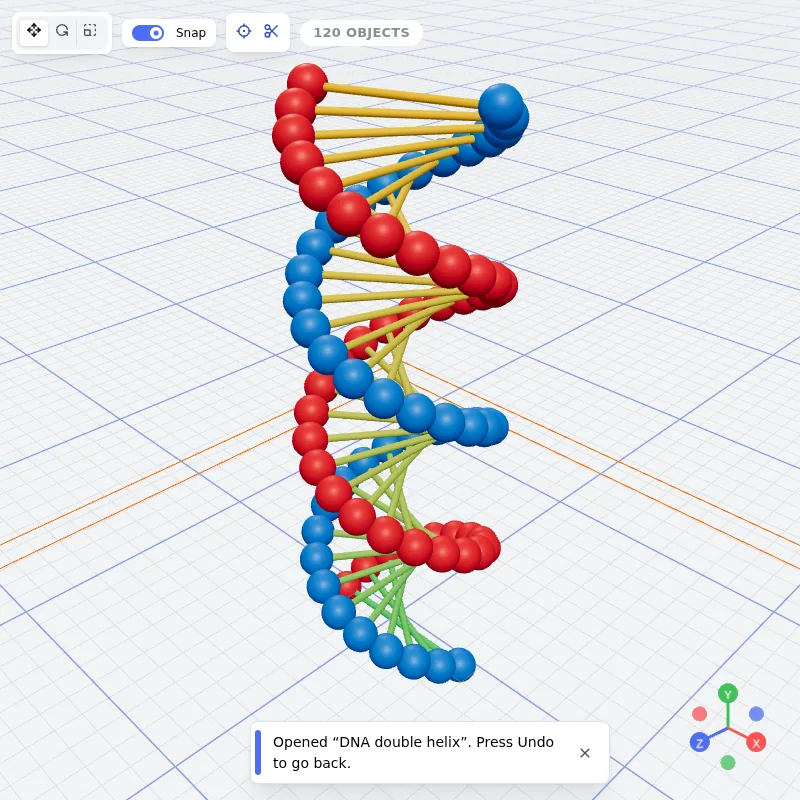
A DNA-style model adds a second strand. A half-turn offset puts the strands on opposite sides, while connecting shapes form the rungs. The ready-made DNA idea is a visual pattern model, not a molecular simulation.
Sunflower: change the radius and turning rule
The sunflower variant uses the golden angle, approximately 137.5°, and
r = R × √(i / (N − 1)). Set climb to zero to view the pattern in a plane. The square-root
growth spreads objects across an area rather than placing most of them near the edge.
Compare the golden angle with 120° or 144°. Rational fractions of a full turn create repeating directions. The golden-angle arrangement avoids a short repeating cycle and produces a different packing pattern.
Try an investigation
- Keep 60 objects, radius 6 and the same shape size.
- Compare turns of 20°, 30° and 45°.
- Predict how many steps make a full turn for each.
- Change only the climb and explain which distances changed.
- Record one object’s index, angle and coordinates as evidence.
Next, explore 2D constructions or use this investigation in a classroom project. The plan comparison lists current pattern and export allowances.